
Literary awards in India recognize excellence in creative writing, research, and linguistic contribution across the 22 languages listed in the Eighth Schedule of the Indian Constitution, as well as English and Rajasthani. These honors are categorized into National-level institutional awards, private foundation awards, and language-specific recognitions.
Jnanpith Award: The Pinnacle of Literary Recognition
Established in 1961 by the Bharatiya Jnanpith (a research and cultural institute founded by the Sahu Jain family), the Jnanpith Award is considered the highest literary honor in India.
- Eligibility: Awarded to Indian citizens only for “outstanding contribution towards literature.” Prior to 1982, it was awarded for a specific work; currently, it is a lifetime achievement award.
- Languages: Works in any of the 22 languages of the Eighth Schedule and English (added later) are considered.
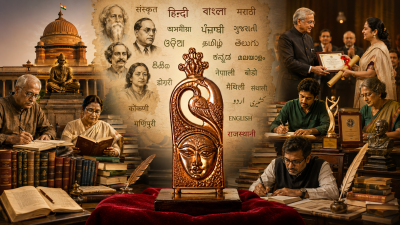
- Components: A cash prize of ₹11 lakh, a citation, and a bronze replica of Vagdevi (Saraswati), the goddess of learning.
- Key Trivia:
- First Recipient: G. Sankara Kurup (Malayalam) in 1965 for Odakkuzhal.
- First Woman Recipient: Ashapoorna Devi (Bengali) in 1976 for Pratham Pratishruti.
- English Entry: Amitav Ghosh (2018) was the first writer to win in the English category.
- 2023-24 Recipients: Gulzar (Urdu) and Jagadguru Rambhadracharya (Sanskrit).
Sahitya Akademi Awards
The Sahitya Akademi, India’s National Academy of Letters (established in 1954), confers these annual awards to recognize the most outstanding books of literary merit published in any of the major Indian languages.
- Linguistic Scope: 24 languages (22 Eighth Schedule languages + English and Rajasthani).
- Process: The selection is made by a three-member jury in each language based on secret ballots.
- Associated Honors:
- Sahitya Akademi Fellowship: The highest honor of the Akademi, higher than the annual award; it is reserved for the “immortals of literature.”
- Bhasha Samman: Awarded to writers/scholars for significant contribution to languages not formally recognized by the Akademi, as well as for classical and medieval literature.
- Yuva Puraskar: Recognizing young writers (under 35).
- Bal Sahitya Puraskar: Recognizing excellence in children’s literature.
Saraswati Samman
Instituted in 1991 by the K.K. Birla Foundation, this is among the most prestigious private literary awards in the country.
- Criteria: Awarded for an outstanding literary work published during the last 10 years in any of the 22 languages of the Eighth Schedule.
- Components: A cash prize of ₹15 lakh, a citation, and a plaque.
- First Recipient: Harivansh Rai Bachchan for his four-volume autobiography.
- Recent Awardee (2023): Prabha Varma for the poetic work Raudra Sathwikam (Malayalam).
Vyas Samman
Also instituted by the K.K. Birla Foundation in 1991, this award is specialized in its focus.
- Focus: Awarded specifically for outstanding literary work in Hindi published during the last 10 years.
- Requirement: The writer must be an Indian citizen.
- First Recipient: Ram Vilas Sharma for Bharat ke Pracheen Bhasha Parivar aur Hindi.
- 2023 Recipient: Pushpa Bharati for her memoir Yaadein, Yaadein aur Yaadein.
Comparison of Major Literary Awards
| Award | Instituted By | First Awarded | Primary Language Scope |
| Jnanpith | Bharatiya Jnanpith | 1965 | 22 Languages + English |
| Sahitya Akademi | Sahitya Akademi (Govt) | 1954 | 24 Languages |
| Saraswati Samman | K.K. Birla Foundation | 1991 | 22 Languages |
| Vyas Samman | K.K. Birla Foundation | 1991 | Hindi Only |
| Bihari Puraskar | K.K. Birla Foundation | 1991 | Hindi/Rajasthani (by Rajasthani authors) |
Moortidevi Award
Another prestigious honor from the Bharatiya Jnanpith, it focuses on literature that highlights Indian philosophy and cultural values.
- Essence: It is given to writers who emphasize “Indian values” in their work.
- Eligibility: All languages mentioned in the Eighth Schedule and English.
- First Recipient: C.K. Nagaraja Rao (Kannada) in 1983.
Regional and State Literary Honours
States across India maintain their own literary academies (Sahitya Parishads) to promote regional dialects and literature.
- Pampa Award (Karnataka): The highest literary honor of the Government of Karnataka, given for works in Kannada.
- Ezhuthachan Puraskaram (Kerala): The highest literary prize of the Kerala state government, named after Thunchaththu Ezhuthachan, the father of the Malayalam language.
- Sahitya Shiromani Samman (Uttar Pradesh): Conferred by the Uttar Pradesh Hindi Sansthan for lifetime contribution to Hindi literature.
- Vachaspati Puraskar: Awarded by the K.K. Birla Foundation specifically for outstanding work written in Sanskrit.
Fact-File for UPSC Prelims
- Constitutional Link: While the awards are not “titles” under Article 18, they are the primary mechanism for the State to fulfill the directive of Article 351 (Development of the Hindi language) and the preservation of regional languages.
- The “English” Distinction: Note that English is NOT an Eighth Schedule language but is recognized by the Sahitya Akademi and the Jnanpith Award committee.
- Posthumous Awards: Sahitya Akademi awards can be given posthumously if the author dies after the submission/consideration period, whereas Jnanpith is generally not awarded posthumously.
- Translation Prizes: The Sahitya Akademi also gives annual Translation Prizes in 24 languages to encourage the cross-pollination of Indian regional literature.