
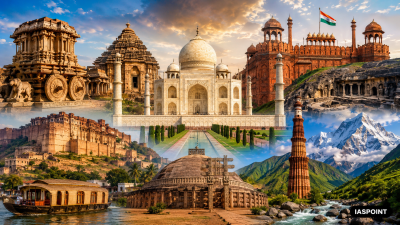
India’s cultural landscape is a repository of millennia-old civilizations, architectural brilliance, and artistic mastery. As of 2026, India hosts 44 UNESCO World Heritage Sites, of which 36 are Cultural, 7 are Natural, and 1 is Mixed (Khangchendzonga National Park). These sites are recognized under the UNESCO World Heritage Convention (1972) for their “Outstanding Universal Value” (OUV).
Overview of UNESCO Cultural World Heritage Sites in India
The cultural sites in India span from the prehistoric era and the Indus Valley Civilization to the medieval marvels of the Mughals and the Cholas, extending to the modern architectural experiments of the 20th century.
| Category | Representative Sites |
| Ancient/Prehistoric | Bhimbetka Rock Shelters, Dholavira (IVC), Nalanda Mahavihara. |
| Cave Architecture | Ajanta, Ellora, Elephanta. |
| Temple Architecture | Konark Sun Temple, Khajuraho, Hampi, Great Living Chola Temples, Pattadakal, Ramappa Temple, Hoysala Ensembles. |
| Mughal Heritage | Taj Mahal, Agra Fort, Fatehpur Sikri, Humayun’s Tomb, Red Fort. |
| Forts & Stepwells | Hill Forts of Rajasthan, Rani-ki-Vav, Maratha Military Landscapes. |
| Colonial & Modern | Churches of Goa, CST Mumbai, Jaipur City, Santiniketan, Le Corbusier’s Work. |
Latest Inscriptions (2023–2025)
The recent additions to the list highlight India’s diverse regional history, from the Ahom burials in the Northeast to the Maratha forts in the West.
Maratha Military Landscapes (2025)
Located primarily in Maharashtra, this serial property represents the military ideology and strategic defensive architecture of the Maratha Empire under Chhatrapati Shivaji Maharaj and subsequent rulers.
- Significance: Showcases a unique integration of physiography with hill, coastal, and island forts.
- Key Forts: Salher, Shivneri, Lohagad, Khanderi, Raigad, Rajgad, Pratapgad, Suvarnadurg, Panhala, Vijaydurg, Sindhudurg, and Gingee Fort (Tamil Nadu).
Moidams – Mound-Burial System of the Ahom Dynasty (2024)
Situated in Charaideo, Assam, these are the “Pyramids of Assam.” They are vaulted mounds (tumuli) used for the burial of Ahom kings and queens.
- Architectural Features: A hemispherical earthen mound (Moidam) with an octagonal dwarf wall and an arched brick structure (Chow-chali).
- Culture: Reflects the Tai-Ahom belief in the afterlife and ancestor worship. It is the first cultural site from Northeast India to be inscribed.
Sacred Ensembles of the Hoysalas (2023)
This serial nomination includes three 12th-13th century temples in Karnataka: Chennakeshava Temple (Belur), Hoysaleswara Temple (Halebidu), and Keshava Temple (Somanathapura).
- Artistic Style: Known for “Soapstone” (Chloritic Schist) carvings that allow for hyper-realistic, intricate detailing.
- Plan: Characterized by the stellate (star-shaped) plan and the Jagati (raised platform).
Santiniketan (2023)
Founded by Maharshi Debendranath Tagore and expanded by Rabindranath Tagore, this university town in West Bengal represents an alternative vision of education and internationalism.
- Focus: It eschews colonial architectural styles in favor of a pan-Asian modernism, integrating nature with learning.
Chronological List of Cultural Sites (1983–2021)
The Early Inscriptions (1983–1989)
- Ajanta Caves (1983): 30 rock-cut Buddhist caves featuring world-renowned mural paintings and sculptures (2nd century BCE to 6th century CE).
- Ellora Caves (1983): 34 caves representing a harmonious mix of Hindu, Buddhist, and Jain traditions. Features the monolithic Kailasa Temple.
- Agra Fort & Taj Mahal (1983): The zenith of Mughal architecture under Akbar and Shah Jahan.
- Sun Temple, Konark (1984): A Kalinga-style chariot-shaped temple dedicated to Surya, built by King Narasimhadeva I (Eastern Ganga Dynasty).
- Mahabalipuram (1984): Pallava rock-cut architecture including Ratha temples, Mandapas, and the “Descent of the Ganges” relief.
- Khajuraho (1986): Chandela dynasty temples known for Nagara-style architecture and erotic sculptures.
- Hampi (1986): The capital of the Vijayanagara Empire; features the Vitthala Temple (musical pillars) and Virupaksha Temple.
- Buddhist Monuments at Sanchi (1989): The Great Stupa commissioned by Ashoka; famous for its intricately carved Toranas (gateways).
Transitions in Architecture (1993–2014)
- Humayun’s Tomb (1993): The first garden-tomb on the Indian subcontinent; inspired the Taj Mahal.
- Qutb Minar & Monuments (1993): Features the 73-meter minaret and the Quwwat-ul-Islam Mosque.
- Mountain Railways of India (1999, 2005, 2008): Includes Darjeeling Himalayan, Nilgiri Mountain, and Kalka-Shimla Railways.
- Mahabodhi Temple (2002): The site where Buddha attained Enlightenment; represents the transition from brick to stone architecture.
- Rani-ki-Vav (2014): An inverted temple-style stepwell in Patan, Gujarat, built by Queen Udayamati (Sanki dynasty).
Civilizational & Modern Sites (2016–2021)
- Nalanda Mahavihara (2016): An ancient international monastic-university (5th–12th century CE) under the Guptas and Palas.
- Historic City of Ahmedabad (2017): India’s first World Heritage City, noted for its “Pols” (traditional residential clusters) and Indo-Islamic architecture.
- Dholavira (2021): A premier Harappan city in Gujarat; noted for its unique water management system and tripartite city planning.
- Ramappa Temple (2021): A Kakatiya-era marvel in Telangana; famous for “floating bricks” and its sandbox foundation for earthquake resistance.
UNESCO Selection Criteria for Cultural Sites
A site must meet at least one of the six cultural criteria to be inscribed:
- Criterion (i): Represents a masterpiece of human creative genius.
- Criterion (ii): Exhibits an important interchange of human values over time.
- Criterion (iii): Bears a unique testimony to a cultural tradition or civilization.
- Criterion (iv): Is an outstanding example of a type of building, architectural or technological ensemble.
- Criterion (v): Is an outstanding example of a traditional human settlement.
- Criterion (vi): Is directly associated with events, living traditions, ideas, or beliefs.
Strategic Trivia for UPSC Prelims
- State with Maximum Sites: Maharashtra (includes Ajanta, Ellora, Elephanta, CST, Victorian Ensembles, and Maratha Military Landscapes).
- First Sites Inscribed: Ajanta, Ellora, Agra Fort, and Taj Mahal (all in 1983).
- Only Mixed Site: Khangchendzonga National Park, Sikkim (meets both cultural and natural criteria).
- The Tentative List: India has over 50 sites on the “Tentative List,” which is a mandatory precursor to the formal nomination for World Heritage status.
- Nodal Agency: The Archaeological Survey of India (ASI) is the primary body for the protection and nomination of cultural sites.