
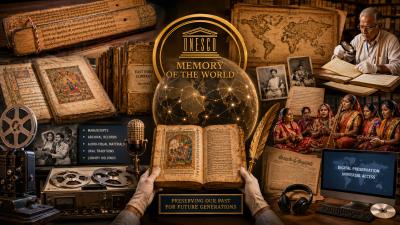
Established by UNESCO in 1992, the Memory of the World (MoW) Programme is dedicated to the preservation of the world’s documentary heritage. This includes manuscripts, oral traditions, audio-visual materials, and archival holdings that possess “world significance” and “outstanding universal value.” For UPSC aspirants, it is essential to distinguish this from the World Heritage Sites (tangible monuments) and Intangible Cultural Heritage (living traditions). The MoW Register specifically targets the recorded memory of humanity to prevent “collective amnesia” and ensure universal access.
India’s 2025 Milestones: The International Register
In April 2025, India achieved a significant diplomatic and cultural feat by securing the inclusion of two foundational Sanskrit texts into the International Memory of the World Register. This brought India’s total count on the International Register to 14 items.
1. The Bhagavadgītā Manuscripts
- Significance: A 700-verse dialogue between Krishna and Arjuna, part of the Bhishma Parva of the Mahabharata.
- Synthesis of Thought: Recognized for its unique synthesis of Vedic, Buddhist, Jain, and Charvaka philosophies.
- Universal Value: UNESCO acknowledged its role as a timeless ethical and spiritual guide translated into over 80 languages.
- Custodian: The manuscripts are preserved at the Bhandarkar Oriental Research Institute (BORI), Pune.
2. The Nāṭyaśāstra of Bharatamuni
- Foundational Treatise: Often called the “Fifth Veda,” it is the world’s most comprehensive ancient manual on performing arts.
- Core Concepts: Outlines the frameworks for Rasa (aesthetic sentiment), Bhava (emotion), Abhinaya (expression), and Sangeeta (music).
- Civilizational Impact: It has governed the evolution of Indian classical dance and drama for over two millennia.
- Custodian: Preserved at BORI, Pune.
India’s 2024 Milestones: The Asia-Pacific Regional Register
While the International Register represents global significance, the Memory of the World Committee for Asia and the Pacific (MOWCAP) maintains a regional register. In May 2024, India successfully inscribed three major works:
| Work | Author | Language/Era | Key Highlights |
| Ramcharitmanas | Goswami Tulsidas | Awadhi (16th C) | A transformative retelling of the Ramayana that popularized the epic in North India. |
| Panchatantra | Pt. Vishnu Sharma | Sanskrit (Ancient) | World-renowned animal fables focusing on Niti (political ethics) and wisdom. |
| Sahṛdayāloka-Locana | Anandavardhana & Abhinavagupta | Sanskrit (9th-10th C) | A seminal text on Indian poetics and the “Dhvani” (suggestion) theory of aesthetics. |
Complete List of Indian Inscriptions (International Register)
As of 2026, the following items from India are inscribed in the UNESCO International MoW Register:
- IAS Tamil Medical Manuscript Collection (1997): Ancient Siddha and Ayurvedic knowledge.
- Rigveda Manuscripts (2007): 30 manuscripts from BORI, Pune, representing the oldest Vedic tradition.
- Saiva Manuscripts in Pondicherry (2005): A collection of 11,000 manuscripts detailing Shaivite Agamas.
- Tarikh-e-Khandan-e-Timuriyah (2011): An illustrated history of the Timurid dynasty from the Mughal era.
- Vimalaprabha (2011): An 11th-century Buddhist commentary on the Kalachakra Tantra.
- Shantinatha Charitra (2013): A 14th-century Jain manuscript with miniature paintings.
- Gilgit Manuscripts (2017): 5th-century Buddhist texts discovered in Gilgit (one of the oldest in India).
- Maitreya Vyakarana (2017): A palm-leaf manuscript regarding the future Buddha.
- Abhinavagupta Manuscripts (2023): Collection on Kashmir Shaivism and aesthetics.
- Archives of the Dutch East India Company (Joint): Shared with Indonesia, Sri Lanka, and South Africa.
- Archives of the Non-Aligned Movement (2023): Joint nomination documenting the 1961 Belgrade Summit.
- Bhagavadgītā (2025): Philosophical and spiritual treatise.
- Nāṭyaśāstra (2025): Treatise on performing arts.
Institutional Framework: The Indian Culture Unit
The Ministry of Culture, through its specialized bodies, acts as the nodal agency for MoW nominations.
Indira Gandhi National Centre for the Arts (IGNCA)
- The Kala Nidhi Division of IGNCA is the primary body that prepares, defends, and submits nominations to UNESCO.
- In 2024, for the first time since the inception of the regional register in 2008, IGNCA submitted and successfully defended three nominations.
National Mission for Manuscripts (NMM)
- Launched in 2003, NMM works under the Ministry of Culture to locate, document, and preserve India’s estimated 10 million manuscripts.
- It identifies “Manuscript Treasures of India” which are subsequently processed for UNESCO nominations.
Quick Trivia for UPSC Prelims
- First Indian Entry: The Tamil Medical Manuscript Collection was the first Indian entry (1997).
- World Cities Day connection: While UCCN cities are announced on Oct 31, MoW entries are typically updated biennially (every two years).
- Oldest Manuscripts: The Gilgit Manuscripts are among the oldest surviving written records in India, dating to the 5th–6th century CE.
- Language Diversity: The register includes texts in Sanskrit, Tamil, Awadhi, Persian (Mughal archives), and Dutch (colonial archives).