
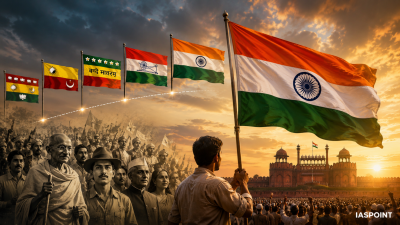
The journey of the Indian National Flag reflects the political milestones of the freedom struggle, evolving from communal symbols to a representation of national unity and sovereignty.
- The First National Flag (1906): Unveiled on August 7, 1906, at Parsi Bagan Square in Calcutta. It comprised three horizontal stripes of green, yellow, and red. The green stripe featured eight white lotuses; the yellow stripe had “Vande Mataram” in Devanagari; and the red stripe depicted a sun and a crescent moon.
- The Berlin Committee Flag (1907): Raised by Madam Bhikaji Cama in Stuttgart, Germany. This was the first Indian flag hoisted on foreign soil. It was similar to the 1906 flag but featured seven stars representing the Saptarishi constellation.
- The Home Rule Movement Flag (1917): Adopted by Bal Gangadhar Tilak and Annie Besant. It featured five red and four green horizontal strips, with the Union Jack in the top left corner, seven stars (Saptarishi), and a crescent moon with a star.
- The Gandhi/Pingali Venkayya Design (1921): Presented at the Bezwada (Vijayawada) session of the All India Congress Committee. It originally consisted of red (Hindus) and green (Muslims) stripes. Upon Gandhi’s suggestion, a white stripe (remaining communities) and a spinning wheel (progress) were added.
- The Swaraj Flag (1931): A landmark resolution was passed in 1931 adopting a tricolor flag. This version featured saffron, white, and green with Gandhi’s spinning wheel (Charkha) in the center. It was the official flag of the Indian National Congress.
- Adoption of the Tiranga (1947): On July 22, 1947, the Constituent Assembly adopted the current National Flag. The Dharma Chakra of Emperor Ashoka replaced the Charkha to ensure the symbol represented eternal motion and virtue rather than a specific socio-economic tool.
Design Specifications and Symbolism
The National Flag of India, known as the Tiranga, is a horizontal tricolor defined by specific geometric and color standards regulated by the Bureau of Indian Standards (BIS).
- Saffron (Kesari): Represents courage, sacrifice, and the spirit of renunciation.
- White: Symbolizes purity, peace, and truth.
- Green: Denotes fertility, growth, and auspiciousness of the land.
- Ashoka Chakra: A 24-spoke wheel in navy blue located in the center of the white stripe. It represents the “Wheel of the Law of Dharma” and indicates that there is life in movement and death in stagnation.
| Feature | Specification |
| Ratio | The ratio of the length to the height (width) of the flag is 3:2. |
| Material | Hand-spun and hand-woven wool/cotton/silk khadi (Amended in 2021 to include polyester). |
| Chakra Origin | Adapted from the Lion Capital of Ashoka at Sarnath. |
| Standardization | Governed by the Flag Code of India, 2002 and the Emblems and Names (Prevention of Improper Use) Act, 1950. |
Constitutional and Legal Framework
The dignity and usage of the National Flag are protected by specific legislative acts and judicial pronouncements.
- Constituent Assembly Committee: The Ad-hoc Committee on the National Flag was headed by Dr. Rajendra Prasad.
- Fundamental Duties: Under Article 51A(a) of the Indian Constitution, it is the duty of every citizen to abide by the Constitution and respect its ideals and institutions, the National Flag, and the National Anthem.
- Flag Code of India, 2002: This code consolidated all laws, conventions, and practices. It is divided into three parts: general description, rules for display by public/private organizations, and rules for display by Central/State governments.
- Naveen Jindal vs. Union of India (2004): The Supreme Court declared that the right to fly the National Flag with respect and dignity is a fundamental right of a citizen within the meaning of Article 19(1)(a) (Right to Freedom of Speech and Expression).
Important Facts and Trivia for Aspirants
- Designer: Pingali Venkayya, an agriculturist and freedom fighter from Andhra Pradesh, is credited as the designer of the precursor to the modern flag.
- First Hoisting: The first time the flag was hoisted on Indian soil after the 1947 adoption was by Jawaharlal Nehru at the Red Fort on August 16, 1947.
- Manufacturing: Traditionally, the Karnataka Khadi Gramodyoga Samyukta Sangha in Hubli is the only licensed unit in India for the production and supply of the National Flag.
- 2021 Amendment: The Flag Code was amended to allow the use of machine-made and polyester flags, previously restricted to hand-spun Khadi, to facilitate initiatives like ‘Har Ghar Tiranga’.
- Half-Mast Protocol: The flag is flown at half-mast as a sign of state mourning. During the death of the President, Vice-President, or Prime Minister, it is flown at half-mast throughout the country.
- Disposal: When the flag is in a damaged or soiled condition, it must be destroyed as a whole in private, preferably by burning or any other method consistent with the dignity of the flag.