
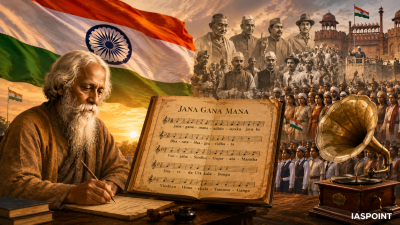
The National Anthem of India, “Jana Gana Mana,” serves as a profound expression of the country’s unity in diversity. Composed originally in Bengali by the polymath Rabindranath Tagore, its journey from a poem to a national symbol is deeply intertwined with the Indian independence movement.
- Original Composition: The anthem is the first stanza of a five-stanza Brahmo hymn titled Bharot Bhagyo Bidhata.
- First Public Performance: It was first sung on December 27, 1911, at the Calcutta Session of the Indian National Congress.
- English Translation: In 1919, Tagore translated the anthem into English while at Besant Theosophical College in Madanapalle, Andhra Pradesh, titling it “Morning Song of India.”
- Musical Score: The musical notation for the anthem is often attributed to Margaret Cousins, a musician and friend of Tagore, who helped set the tune during his visit to Madanapalle.
- Official Adoption: The Constituent Assembly of India officially adopted “Jana Gana Mana” as the National Anthem on January 24, 1950. On the same day, “Vande Mataram” was designated as the National Song, enjoying equal status.
Structural and Musical Specifications
The National Anthem is governed by specific protocols regarding its duration, lyrics, and the context of its performance to maintain its sanctity.
- Full Version Duration: The playing time of the full version of the National Anthem is approximately 52 seconds.
- Short Version: A short version consisting of the first and last lines (playing time approximately 20 seconds) is played on certain ceremonial occasions.
- Lyrics and Language: While the original was in Bengali (Sanskritized Bengali known as Sadhu Bhasha), the official version is the Hindi transliteration.
- Meaning of the Stanza: The lyrics enumerate various geographical regions (Punjab, Sindh, Gujarat, Maratha, Dravida, Utkala, Banga), the mountain ranges (Vindhya, Himachal), and the rivers (Yamuna, Ganga), invoking a blessing for the nation’s destiny.
Constitutional and Legal Framework
The respect and protection of the National Anthem are enshrined in the Indian legal and constitutional system, making it a mandatory observance for all citizens.
- Article 51A(a): As per the Constitution of India, it is a Fundamental Duty of every citizen to abide by the Constitution and respect its ideals and institutions, including the National Flag and the National Anthem.
- Prevention of Insults to National Honour Act, 1971: Section 3 of this Act prescribes punishment (imprisonment up to three years or fine) for anyone who intentionally prevents the singing of the National Anthem or causes disturbances to any assembly engaged in such singing.
- Supreme Court Rulings:
- Bijoe Emmanuel vs. State of Kerala (1986): The Supreme Court held that no person can be compelled to sing the National Anthem if they have a genuine conscientious religious objection, provided they stand up respectfully when it is played.
- Shyam Narayan Chouksey vs. Union of India (2016/2018): Initially, the Court mandated playing the anthem in cinema halls. In 2018, it modified this order, making the playing of the anthem in cinemas optional rather than mandatory.
Important Facts and Trivia for Civil Services
The following table and list provide a 360-degree view of the unique facts associated with the National Anthem for competitive exams.
| Fact Category | Detail |
| Composer | Rabindranath Tagore (The only person to have composed the national anthems of two nations: India and Bangladesh). |
| First Recording | The first recorded version was performed by Tagore himself in 1912. |
| Netaji’s Contribution | Subhash Chandra Bose commissioned a Hindustani adaptation called Subh Sukh Chain for the Azad Hind Fauj. |
| Global Debut | It was performed by a foreign orchestra in 1942 at Hamburg, Germany, during the founding of the German-Indian Society. |
- Madanapalle Connection: Known as the “Birthplace of the National Anthem” because Tagore stayed there for six days and created the English translation and musical setting.
- The UN Performance: In 1947, a recording of “Jana Gana Mana” was played at the United Nations in New York before the General Assembly, where it was highly acclaimed by representatives of various nations.
- Official Language of Translation: Captain Abid Ali of the Indian National Army (INA) translated the anthem into Hindustani, which was used by Netaji’s forces.
Code of Conduct for Citizens
The Government of India has issued specific instructions regarding the etiquette to be followed during the performance of the National Anthem.
- Standing Position: Whenever the National Anthem is sung or played, the audience shall stand to attention.
- Exemptions: However, when the anthem is played in the course of a newsreel or documentary as part of the film, the audience is not expected to stand, as standing would cause confusion and disturbance to the screening.
- Indiscriminate Use: The anthem should not be played indiscriminately; it must be performed only on occasions specified by the government (e.g., Civil and Military investitures, National Days, arrival of the President at formal functions).
- Singing in Schools: The government encourages the mass singing of the National Anthem in schools as a means of instilling patriotism among the youth.