

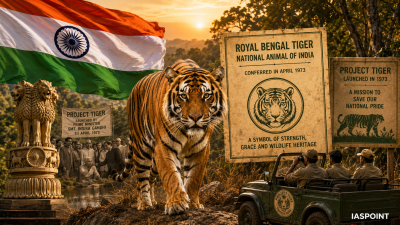
The Royal Bengal Tiger was conferred the status of the National Animal of India in April 1973, replacing the Lion. This change was primarily driven by the need to highlight the urgency of tiger conservation and the launch of “Project Tiger.”
- Symbolism: It represents power, agility, and tremendous policy strength. It is often referred to as the “Lord of the Jungle.”
- Conservation Status: Listed as ‘Endangered’ on the IUCN Red List and under Schedule I of the Wildlife (Protection) Act, 1972.
- Project Tiger (1973): Launched from the Jim Corbett National Park, this remains one of the world’s most successful species-specific conservation programs.
- Distribution: India is home to over 70% of the world’s wild tiger population, spread across various Tiger Reserves governed by the National Tiger Conservation Authority (NTCA).
National Bird: Indian Peacock (Pavo cristatus)
The Indian Peacock was declared the National Bird of India in 1963. Its selection was based on its widespread presence across the country and its deep-rooted significance in Indian mythology and folklore.
- Features: The male is more colorful than the female, possessing a glistening blue breast and a long spectacular tail of some 200 elongated feathers.
- Legal Protection: It is fully protected under the Wildlife (Protection) Act, 1972. It is an offense to kill or harm the peacock in any part of the country.
- Cultural Identity: The peacock is associated with Lord Kartikeya and Goddess Saraswati. In Indo-Islamic architecture, the “Peacock Throne” (Takht-i-Taus) of the Mughals is a famous historical reference.
National Flower: Lotus (Nelumbo nucifera)
The Lotus is the National Flower of India, holding a unique position in the art and mythology of ancient India.
- Symbolism: It represents divinity, fertility, wealth, knowledge, and enlightenment. Despite growing in mud, it remains untouched and pure, symbolizing the triumph of the spirit over material matter.
- Historical Presence: The lotus motif is found extensively in the Sanchi Stupa, the Ajanta and Ellora caves, and various temple architectures.
- Scientific Utility: Beyond its cultural value, different parts of the lotus (roots, seeds, and petals) have significant uses in traditional Indian medicine (Ayurveda).
National Tree: Banyan Tree (Ficus benghalensis)
The Banyan tree, also known as the “Vat” or “Bargad,” was adopted as the National Tree of India due to its longevity and the vast area its branches cover.
- Symbolism: Often called the “Kalpavriksha” (Wish-fulfilling tree), it symbolizes eternal life and immortality because of its expanding branches and aerial roots that grow into new trunks.
- Ecological Significance: It serves as a focal point for village life; the “village panchayat” was traditionally held under the shade of a Banyan tree. It supports a massive ecosystem of birds, insects, and small mammals.
- Medicinal Properties: In Ayurveda, the bark, leaves, and milky sap of the Banyan are used to treat various ailments, including inflammation and dysentery.
Summary of Other National Insignia
While the primary four insignia are frequently cited, several other biological and cultural entities are recognized as national symbols to represent India’s diverse heritage.
| Category | National Insignia | Scientific Name | Significance |
| National Fruit | Mango | Mangifera indica | Representing the “King of Fruits”; indigenous to India since ancient times. |
| National River | Ganga | – | Declared in 2008 to aid the “Clean Ganga” mission; holiest river in Hinduism. |
| National Heritage Animal | Indian Elephant | Elephas maximus | Declared in 2010 to increase awareness about the conservation of elephants. |
| National Aquatic Animal | Ganges River Dolphin | Platanista gangetica | Representing the purity of the holy Ganga; an indicator of a healthy river ecosystem. |
| National Reptile | King Cobra | Ophiophagus hannah | Significant in Indian mythology (Naga worship) and a key apex predator. |
Comparative Fact Sheet for Aspirants
- The Transition of 1973: Before 1973, the Lion was the National Animal. The shift to the Tiger coincided with the realization that the tiger population was more widely distributed across the Indian landscape compared to the Asiatic Lion, which is restricted to the Gir Forest.
- National Calendar: India uses the Saka Era calendar (commencing in 78 AD). It was adopted on March 22, 1957, along with the Gregorian calendar. Chaitra is the first month and Phalguna is the last.
- National Currency Symbol: The Indian Rupee symbol (₹) was designed by Udaya Kumar Dharmalingam and adopted on July 15, 2010. It is a blend of the Devanagari ‘Ra’ and the Roman capital ‘R’.
- Legal Mandates: All National Insignia are protected under the State Emblem of India (Prohibition of Improper Use) Act, 2005, and various environmental protection laws. Desecration or improper representation is a punishable offense.
- UNESCO Recognition: Many habitats of these national symbols, such as the Sundarbans (Tiger) and the Nanda Devi Biosphere Reserve, are recognized as UNESCO World Heritage sites, highlighting their global ecological importance.