
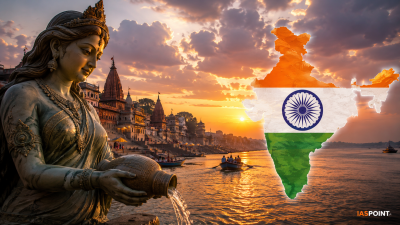
The River Ganga was officially declared as the National River of India on November 4, 2008. This declaration was a strategic move by the Government of India to recognize the river’s unparalleled significance in the country’s cultural, spiritual, and ecological landscape, and to provide a unified framework for its conservation.
- Proclamation: The Prime Minister of India announced the status during the first meeting of the National Ganga River Basin Authority (NGRBA).
- Symbolic Value: It is revered as ‘Ganga Maiya’ (Mother Ganga) and is a central motif in the socio-religious fabric of India, symbolizing purity and the lifeline of millions.
- Socio-Economic Importance: The Ganga basin is the most populated river basin in the world, supporting more than 40% of India’s population and contributing significantly to the nation’s agricultural output.
Geographical and Hydrological Profile
A 360° understanding of the National River requires a look at its physical journey and its status as a transboundary river.
- Origin: The river rises in the Gangotri Glacier in the Himalayas at an elevation of approximately 3,892 meters in the Uttarkashi district of Uttarakhand.
- Panch Prayag: The river takes the name ‘Ganga’ only after the confluence of the Alaknanda and Bhagirathi at Devprayag.
- Course: It flows through the states of Uttarakhand, Uttar Pradesh, Bihar, and West Bengal before entering Bangladesh and emptying into the Bay of Bengal.
- Major Tributaries:
- Left Bank: Ramganga, Garra, Gomti, Ghaghara, Gandak, Burhi Gandak, Kosi, and Mahananda.
- Right Bank: Yamuna (the largest tributary), Son, Punpun, and Damodar.
- Length: Approximately 2,525 km, making it the longest river flowing entirely within India.
Institutional and Legal Framework for Protection
Since its declaration as the National River, several specialized bodies and missions have been established to ensure its rejuvenation and pollution abatement.
- National Ganga Council (NGC): Replaced the NGRBA in 2016. It is headed by the Prime Minister and is responsible for the superintendence of pollution prevention and rejuvenation of the Ganga basin.
- National Mission for Clean Ganga (NMCG): The implementation wing of the NGC. It acts as the registered society to execute the “Namami Gange” project.
- Namami Gange Programme: An Integrated Conservation Mission, approved as a ‘Flagship Programme’ in June 2014 with a budget outlay of ₹20,000 crore. Its pillars include:
- Sewerage Treatment Infrastructure
- River-Front Development
- River-Surface Cleaning
- Bio-Diversity conservation
- Afforestation and Public Awareness
- Legal Status of a “Living Entity”: In 2017, the Uttarakhand High Court declared the Ganga and Yamuna rivers as “living entities” (legal persons), giving them the same legal rights as human beings, though this was later stayed by the Supreme Court.
Cultural and Ecological Identity
The Ganga is not merely a water body but a cultural repository and a unique ecosystem.
- Religious Significance: It is the site of the Kumbh Mela, the world’s largest religious gathering, inscribed on the UNESCO Representative List of the Intangible Cultural Heritage of Humanity.
- Ganga Dolphin: The Ganges River Dolphin (Platanista gangetica), found in the river, is the National Aquatic Animal of India. It is a reliable indicator of the river’s health.
- Self-Purifying Property: Historically and scientifically, the Ganga water is known for its “non-putrefying” quality. Research attributes this to the presence of high levels of Bacteriophages (viruses that kill bacteria) and a high rate of oxygen retention.
- Cultural Inscriptions: The river finds mention in the Rig Veda (Nadistuti Sukta) and is depicted in the famous rock relief “Descent of the Ganges” at Mahabalipuram (a UNESCO World Heritage Site).
Fact Sheet for UPSC Aspirants
| Aspect | Fact / Detail |
| Year of Declaration | 2008 |
| Headquarters of NMCG | New Delhi |
| First State it enters | Uttarakhand |
| Last State in India | West Bengal |
| Largest Tributary | Yamuna |
| Delta | Sundarbans Delta (World’s largest delta, shared with Bangladesh) |
| National Waterway 1 | The Prayagraj-Haldia stretch of the Ganga-Bhagirathi-Hooghly river system. |
Major Challenges and Initiatives
- Pollution Sources: Domestic sewage (70-80% of the load), industrial effluents (especially from tanneries in Kanpur), and agricultural runoff.
- Arth Ganga: A recent sustainable development model that focuses on economic activities related to the river to link the river rejuvenation with the livelihood of the people.
- Ganga Praharis: A cadre of self-motivated volunteers from local communities working for the conservation of the Ganga’s biodiversity.
- Bhuvan Ganga App: A mobile application launched to facilitate public participation in monitoring pollution and providing real-time data to the NMCG.