
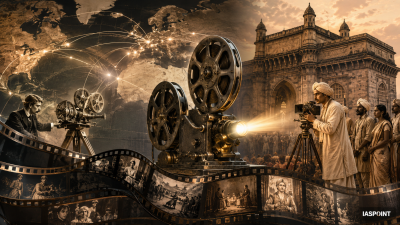
The inception of Indian cinema was not a localized event but a subset of a global technological revolution.
The Genesis: Arrival of the Cinématographe (1896)
The history of motion pictures in India began on July 7, 1896, at the Watson’s Hotel in Bombay (now Mumbai). The Lumière brothers’ agents screened six short films, including The Arrival of a Train and The Sea Bath.
- Initial Reception: These “living photographic pictures” were initially restricted to the colonial elite.
- Hiralal Sen: Often credited with the first Indian effort, Sen filmed stage productions in Calcutta in 1898. His company, Royal Bioscope Company, was a pioneer in the Bengal region.
- H.S. Bhatavdekar (Sawe Dada): Recorded a wrestling match in Bombay’s Hanging Gardens in 1899, often cited as the first “factual” film made by an Indian.
Dadasaheb Phalke: The Father of Indian Cinema
Dhundiraj Govind Phalke, popularly known as Dadasaheb Phalke, transformed cinema from a novelty into an art form. Inspired by the film The Life of Christ, Phalke sought to Indianize the medium by drawing from the Puranas and Epics.
Raja Harishchandra (1913)
- Status: India’s first indigenous full-length feature film.
- Release Date: May 3, 1913, at the Coronation Cinematograph, Bombay.
- Key Features: It was a silent film with intertitles in Marathi and Hindi. Due to social taboos, female roles were played by men (Anna Salunke played the role of Taramati).
- Impact: It established the Mythological Genre, which dominated the silent era and remains a staple of Indian storytelling.
| Feature | Details |
| Director | Dadasaheb Phalke |
| Studio | Phalke’s Films (Nashik) |
| Genre | Mythological |
| Total Length | Approx. 3700 feet (4 reels) |
Growth of Regional Centers and Production Houses
Post-1913, the industry expanded beyond Bombay. Various production houses emerged, setting the stage for the studio system.
- Madras (South India): R. Nataraja Mudaliar established the India Film Company. In 1916, he produced Keechaka Vadham, the first silent film in South India.
- Calcutta (East India): J.F. Madan founded Madan Theatres, which became a dominant force in production and distribution across India and Burma.
- Maharashtra: The Prabhat Film Company (1929) in Kolhapur (later moved to Pune) introduced sophisticated technical standards.
Technical and Social Characteristics of Silent Films
During this period, Indian cinema was characterized by specific narrative styles and technical constraints.
Narrative Styles
- Mythologicals & Devotionals: Stories from the Ramayana, Mahabharata, and lives of saints (e.g., Satyavan Savitri, Bhakta Vidur).
- Social Awareness: While rare, some films began addressing social issues. Bhakta Vidur (1921) was the first film to be banned in India due to its political overtones reflecting the Gandhian movement.
Technical Milestones
- Natural Lighting: Most films were shot in sunlight using reflectors, as artificial studio lighting was expensive and rare.
- Hand-Tinting: Some frames were hand-painted to provide a semblance of color.
- Live Orchestration: Since the films were silent, theaters employed live musicians (tabla, harmonium) to provide background scores.
Significant Personalities of the Silent Era
- Ardeshir Irani: Before making the first talkie, he founded Star Film Company and produced numerous silent films emphasizing high production values.
- V. Shantaram: A stalwart of the Prabhat Film Company, known for his technical prowess and later, his socially relevant themes.
- Fatma Begum: India’s first female director who started her own production house, Fatma Films, in 1926 and directed Bulbul-e-Paristan.
- Sulkoche (Ruby Myers): One of the highest-paid silent film stars, representing the Baghdadi Jewish community’s significant contribution to early Indian cinema.
Transition to the Talkies (1931)
The silent era effectively concluded in 1931 with the release of Alam Ara by Ardeshir Irani. The introduction of sound changed the dynamics of Indian cinema, shifting the focus to dialogue, music, and the standardization of Hindustani as a cinematic language.
Fact Sheet for UPSC Prelims
- First Film Screened in India: July 7, 1896 (Watson’s Hotel, Bombay).
- First Indian to make a film: H.S. Bhatavdekar (The Wrestlers, 1899).
- First Feature Film: Raja Harishchandra (1913).
- First South Indian Feature Film: Keechaka Vadham (1916).
- First Female Director: Fatma Begum (1926).
- Dadasaheb Phalke Award: Instituted in 1969 by the Government of India to recognize exemplary contributions to Indian cinema. Devika Rani was the first recipient.
- The First International Success: The Light of Asia (Prem Sanyas, 1925), co-produced with German technicians and directed by Himanshu Rai.