

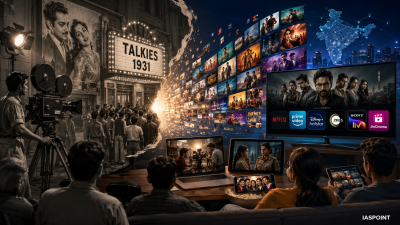
The emergence of Over-the-Top (OTT) platforms has triggered the most significant structural shift in the Indian film industry since the transition to talkies in 1931. This digital disruption has democratized content creation, altered consumption patterns, and challenged the traditional hegemony of the theatrical “Star System.”
Evolution of Digital Streaming in India
The Indian OTT landscape evolved through distinct phases, moving from a niche service for urban elites to a mass-market utility.
- Early Phase (2008–2015): The launch of BigFlix by Reliance Entertainment in 2008 marked the beginning, followed by early players like NexGTv and dittoTV.
- The 4G Catalyst (2016): The launch of Reliance Jio and the subsequent “data revolution” provided the high-speed infrastructure necessary for video streaming.
- The Global Entry (2016–2017): Netflix and Amazon Prime Video entered the Indian market, focusing initially on licensed Bollywood content before pivoting to “Originals.”
- The Pandemic Acceleration (2020–2021): The closure of cinema halls led to the “Direct-to-Digital” release model, where major films bypassed theaters entirely.
Structural Impact on the Film Industry
OTT platforms have redefined the economics and aesthetics of Indian storytelling, creating a “Parallel Cinema 2.0.”
- Democratic Distribution: Small-budget films that previously struggled for screen time (theaters) now find a global audience instantly.
- The “Long-Form” Narrative: The rise of limited series (e.g., Sacred Games, Paatal Lok) has allowed for character depth and complex subplots that the 2.5-hour theatrical format could not accommodate.
- The Rise of the “Actor” over the “Star”: Performers like Pankaj Tripathi, Manoj Bajpayee, and Nawazuddin Siddiqui gained mainstream stardom through OTT, shifting the focus from physical glamour to raw talent.
- Linguistic Convergence: Subtitles and dubbing have made regional cinema (Tamil, Telugu, Malayalam, Bengali) accessible to North Indian audiences, fostering a truly “Pan-Indian” cinematic culture.
Regulatory Framework and IT Rules, 2021
Unlike theatrical releases governed by the Cinematograph Act, 1952, OTT content was largely self-regulated until 2021.
The IT (Intermediary Guidelines and Digital Media Ethics Code) Rules, 2021
The Ministry of Information and Broadcasting (MIB) introduced a three-tier grievance redressal mechanism:
- Level I: Self-regulation by the publishers (appointment of a Grievance Redressal Officer).
- Level II: Self-regulation by the self-regulating bodies of the publishers.
- Level III: Oversight mechanism by the Central Government (Inter-Departmental Committee).
Content Classification for OTT
Publishers must classify content into five age-based categories:
- U: Universal
- U/A 7+: Universal/Adult (7 years and above)
- U/A 13+: Universal/Adult (13 years and above)
- U/A 16+: Universal/Adult (16 years and above)
- A: Adult
Economic and Cultural Comparison: OTT vs. Theatrical
| Feature | Theatrical Cinema | OTT Platforms |
| Revenue Model | Box Office collections (Tickets) | Subscription (SVOD) or Advertising (AVOD) |
| Primary Regulation | CBFC (Central Board of Film Certification) | IT Rules 2021 (Self-regulation with oversight) |
| Creative Freedom | Restricted by censorship and commercial pressure | High (explores taboo and gritty realism) |
| Audience Reach | Geographical (Limited by screens) | Global (Limited by internet access) |
| Longevity | Short shelf life (2–4 weeks) | Permanent digital library |
Technological Trends Shaping the Future
The future of Indian cinema lies in the convergence of AI, virtual production, and personalized viewing.
- Virtual Production (Volume Stages): Use of LED walls and real-time rendering engines (Unreal Engine) reduces the need for location scouting and physical sets.
- AI and Post-Production: Artificial Intelligence is being used for automated subtitling, deep-fake technology for de-aging actors, and predictive analytics to determine script success.
- Metaverse and VR: Experimental projects are exploring “Interactive Cinema” where viewers can choose the narrative path of the story.
Major OTT Platforms and Key Milestones
- Hotstar (now Disney+ Hotstar): Pioneer of the “Freemium” model in India; leveraged live sports (IPL) to scale.
- Netflix India: Known for high production values and global reach for Indian stories like Delhi Crime (first Indian series to win an International Emmy).
- Amazon Prime Video: Focused on localized content and “Massy” narratives like Mirzapur and The Family Man.
- Regional Players: Platforms like Hoichoi (Bengali), Aha (Telugu), and Planet Marathi cater specifically to linguistic identities, preserving local art forms.
Fact Sheet for UPSC Prelims
- First Indian OTT Original: Sacred Games (2018) produced by Netflix.
- First International Emmy for India: Delhi Crime (Best Drama Series, 2020).
- Grievance Redressal: Under the 2021 Rules, the Grievance Officer must acknowledge a complaint within 24 hours and resolve it within 15 days.
- Soft-Touch Regulatory Architecture: The government’s term for the IT Rules 2021, implying a balance between freedom and accountability.
- The “Hybrid” Future: Post-2022, the industry has settled into a “Windowing” model, where films release in theaters first and move to OTT after a 4-to-8-week gap.
- Intangible Heritage: The National Film Archive of India (NFAI) is currently grappling with the challenge of “Digital Preservation” for content that exists only on streaming servers and not on physical film.