
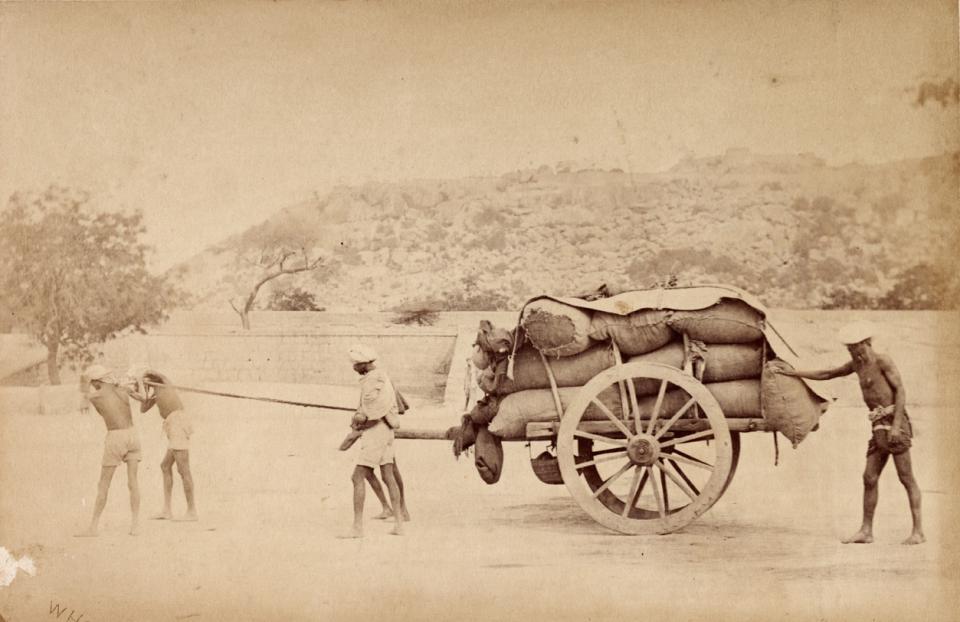
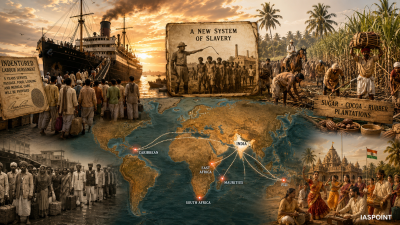
The Indian Indentured Labour system was established in the 1830s following the abolition of slavery in the British Empire. Often termed “A New System of Slavery,” it involved the migration of over 1.3 million Indians to various European colonies to work on sugar, cocoa, and rubber plantations. This forced migration laid the foundation for the “Girmitiya” ideology and the subsequent global spread of Indian culture.
Geographical Distribution and Major Destinations
The movement of labor was primarily governed by the “Kangani” and “Maistry” systems in Southeast Asia and the formal indenture contracts in the Caribbean and Pacific.
| Region | Major Colonies | Primary Source Regions in India |
| Caribbean | Guyana, Trinidad and Tobago, Suriname, Jamaica | United Provinces (UP), Bihar (Bhojpuri belt) |
| Indian Ocean | Mauritius, Reunion Island, Seychelles | Bihar, Bengal, Tamil Nadu |
| Pacific | Fiji | Uttar Pradesh, Bihar, South India |
| Africa | South Africa (Natal), East Africa | Tamil Nadu, Andhra Pradesh, Gujarat |
| Southeast Asia | Malaysia, Sri Lanka, Myanmar | Tamil Nadu (Madras Presidency) |
Evolution of the “Girmitiya” Identity
The term “Girmit” is a dialectal corruption of the English word “Agreement.” The laborers, known as Girmitiyas, developed a unique subculture born out of the “Jahaji-Bhai” (Ship-Brotherhood) bond. This bond transcended caste and religious barriers, as the shared trauma of the long sea voyage (Kala Pani) necessitated communal living and mutual support.
Religious Preservation and Adaptation
Despite missionary pressures, the Indian diaspora maintained their spiritual roots through oral traditions and communal worship.
Persistence of Puranic and Epic Traditions
- Ramcharitmanas: Tulsidas’s Ramayana became the most significant cultural anchor for the Bhojpuri-speaking diaspora. It provided a narrative of exile and ultimate return/triumph that mirrored their own lives.
- Hanuman Chalisa: Regular recitals served as a source of strength and communal gathering.
- Bhakti Movement Influence: The egalitarian nature of the Bhakti tradition helped the diaspora ignore rigid caste hierarchies that were difficult to maintain in plantation barracks.
Festivals and Public Rituals
- Maha Shivaratri: In Mauritius, the “Grand Bassin” (Ganga Talao) is considered a sacred lake, creating a symbolic link to the River Ganges.
- Hosay (Muharram): In Trinidad and Guyana, Muharram evolved into “Hosay,” a commemorative procession involving both Hindus and Muslims, symbolizing a syncretic cultural identity.
- Deepavali and Holi: These festivals were adapted using local materials, often becoming public holidays in countries like Fiji and Mauritius.
Linguistic Transformation and Literature
The indentured system led to the birth of new “Koiné” languages—hybrid dialects that allowed communication between diverse linguistic groups.
- Caribbean Hindustani: A mixture of Bhojpuri, Awadhi, and Magahi with English, Dutch, and French loanwords.
- Fiji Hindi: A distinct dialect evolved from Eastern Hindi, incorporating English and native Fijian words.
- Mauritian Bhojpuri: Now recognized as a national language of Mauritius, it remains a primary vehicle for folk songs and oral history.
Impact on Culinary Arts and Material Culture
Indian food underwent significant localization, leading to the creation of iconic “fusion” cuisines that are now national dishes in host countries.
- Chutney-Soca Music: In the Caribbean, traditional Bhojpuri folk songs merged with local Soca and Calypso rhythms.
- The “Roti” Culture: Variations like the “Buss-up-shut” (paratha) in Trinidad and “Dhal Puri” in Suriname became staples of the local diet.
- Bunny Chow: In South Africa, a hollowed-out loaf of bread filled with curry was invented by Indian laborers to carry food to the fields.
Socio-Political Contribution and Global Influence
The indentured diaspora eventually transitioned from laborers to landowners, professionals, and political leaders.
- Political Leadership: Descendants of indentured laborers have served as Heads of State in Mauritius, Guyana, Trinidad and Tobago, and Seychelles.
- The Aapravasi Ghat: Located in Mauritius, this UNESCO World Heritage site marks where the first indentured laborers landed, serving as a global symbol of the “Great Experiment.”
- Satyagraha in South Africa: The struggle of indentured Indians against the “3-pound tax” and the “Black Act” provided Mahatma Gandhi with the laboratory to refine his philosophy of non-violent resistance.
Factful Trivia for UPSC Prelims
- 1834: The year the first batch of Indian laborers arrived in Mauritius on the ship Atlas.
- Tola and Kanta: In the Caribbean, these terms refer to the weighing scales and the “hook” used by recruiters, respectively, symbolizing the exploitative nature of the trade.
- Indenture Abolition: The system was officially abolished in 1917, largely due to the efforts of Indian nationalists like Gopal Krishna Gokhale and C.F. Andrews.
- Pravasi Bharatiya Divas: Celebrated on January 9th, it commemorates the return of Mahatma Gandhi from South Africa, honoring the contribution of the overseas Indian community.
- Kala Pani: The Hindu taboo against crossing the sea, which was systematically broken by the indentured system, leading to a permanent change in social structures.