
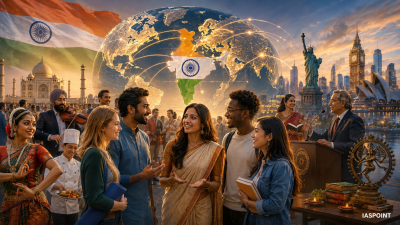
The Indian diaspora, exceeding 32 million globally, serves as a “living bridge” that projects India’s soft power. Unlike traditional diplomacy conducted through state actors, the diaspora facilitates a grassroots-level “bottom-up” diffusion of Indian heritage, values, and traditions. This organic advocacy shapes global perceptions and fosters international goodwill without direct state intervention.
Key Domains of Cultural Advocacy
Language and Literature (Vishwa Hindi Diwas)
The diaspora has been instrumental in the global institutionalization of Indian languages.
- Sanskrit and Hindi: Through institutions like the World Hindi Secretariat in Mauritius and Hindi chairs in universities like Columbia and Oxford, the diaspora preserves linguistic roots.
- Diasporic Literature: Writers like V.S. Naipaul, Jhumpa Lahiri, and M.G. Vassanji have integrated the Indian immigrant experience into the global literary canon, winning prestigious awards like the Nobel and Pulitzer.
The “Yoga and Ayurveda” Revolution
The diaspora played a pivotal role in transitioning Yoga from a localized spiritual practice to a multibillion-dollar global wellness industry.
- International Recognition: The advocacy of the diaspora was central to the UN’s declaration of June 21 as International Day of Yoga.
- Ayurveda: Indian-origin practitioners in the West have led the demand for herbal and holistic medicine, leading to the establishment of Ayurvedic research centers in Europe and North America.
Performing Arts and Cinema
Indian classical and folk arts are preserved through “Guru-Shishya” traditions established in foreign lands.
- Classical Dance: Numerous academies for Bharatanatyam and Kathak in the US, UK, and Canada ensure these art forms are performed at prestigious venues like Lincoln Center.
- Bollywood and Music: The popularity of Indian cinema in Central Asia, the Middle East, and Africa is largely sustained by the local Indian community. Collaborative genres like “Chutney-Soca” in the Caribbean exemplify cultural fusion.
Religious Diplomacy and Spiritual Centers
The diaspora has financed and constructed monumental spiritual landmarks that serve as architectural ambassadors of Indian heritage.
| Landmark | Location | Cultural Significance |
| BAPS Swaminarayan Akshardham | Robbinsville, USA | The largest Hindu temple in the Western Hemisphere; showcases ancient stone carving techniques. |
| Batu Caves | Selangor, Malaysia | A major center for the Thaipusam festival, drawing millions of international tourists. |
| Ganga Talao | Savanne, Mauritius | Created as a symbolic equivalent to the Ganges for the Girmitiya descendants. |
| Neasden Temple | London, UK | One of the first traditional marble Hindu temples built outside India. |
Soft Power through Gastronomy (Culinary Diplomacy)
The “curry-fication” of global palates is perhaps the most visible impact of the diaspora.
- National Dishes: Chicken Tikka Masala is often cited as a true British national dish, reflecting the integration of Indian flavors into Western diets.
- GI Products: The diaspora creates a steady demand for Geographical Indication (GI) tagged products like Basmati rice and Darjeeling tea, bolstering India’s export economy.
Institutional Mechanisms for Engagement
The Government of India leverages several programs to formalize the role of the diaspora as cultural ambassadors.
- Know India Programme (KIP): A 25-day orientation program for diaspora youth to familiarize them with Indian art, heritage, and contemporary progress.
- Bharat Ko Janiye Quiz: An online initiative to motivate the diaspora to learn about Indian culture and history.
- Vishwa Hindi Samman: Awarded to individuals (often diaspora members) for their contribution to the promotion of the Hindi language abroad.
- ICCR Scholarships: The Indian Council for Cultural Relations provides scholarships for diaspora students to study Indian classical music, dance, and weaving.
Socio-Political Influence and Lobbying
The diaspora acts as a pressure group that influences the foreign policies of host nations in favor of Indian interests.
- The “Samosa Caucus”: A term used for the growing number of Indian-origin lawmakers in the US Congress who influence bilateral ties.
- Civil Nuclear Deal: The Indian-American community was highly influential in the passage of the 123 Agreement (Indo-US Civil Nuclear Deal).
Factful Trivia for UPSC Aspirants
- Largest Diaspora: As per the UN International Migration Report, India has the world’s largest diaspora, followed by Mexico and Russia.
- Pravasi Bharatiya Samman: The highest honor conferred on overseas Indians, recognizing their role in enhancing India’s prestige.
- Indologist Recognition: The diaspora often supports the work of foreign Indologists, ensuring the academic study of Indian civilization continues globally.
- Soft Power Rank: India’s soft power ranking has consistently improved due to the “3D” advantage: Diaspora, Digitalization, and Democracy.
- UNESCO Sites: The diaspora is often active in advocating for the UNESCO World Heritage status of sites related to Indian history abroad, such as Aapravasi Ghat in Mauritius.